GAMZE GÜLEZ
hyperbolic surfaces
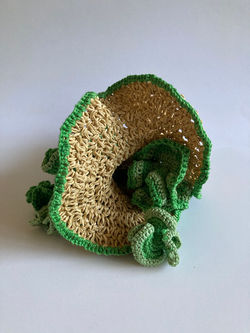
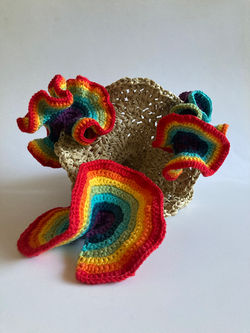
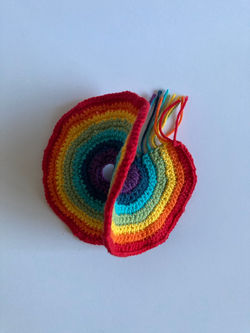
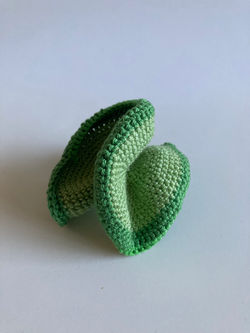
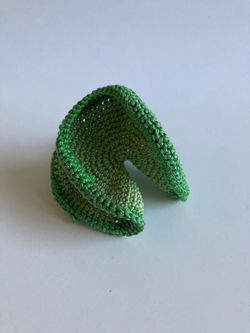
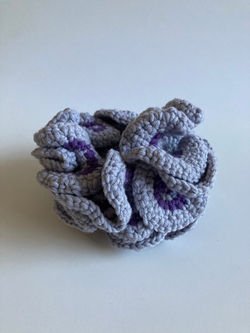
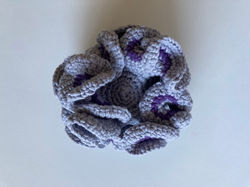
A hyperbolic surface is a surface with negative curvature, defined by an exponential growth that constantly pushes the structure outward, creating folds. A faster rate of growth over a surface area leads to a more ruffled, compactly folded shape.
Such surfaces are not just in the realm of geometry; from the ruffled edge of a sea slug, corals to the lettuce leaves there are numerous examples in nature.These natural forms adopt hyperbolic shapes to maximize surface area within a given volume, which is critical for nutrient absorption and exchange.
To model these structures, I use crochet which has been popularized by the mathematician Daina Taimina. When crocheting with a constant increase in stitches per row (i.e., maintaining a constant, exponential growth), the fabric naturally begins to ruffle and fold, demonstrating the negative curvature of hyperbolic space.
By increasing and decreasing growth rate, changing the algorithm, I end up with something unique each time. Which also pops in questions of differential growth and morphogenesis, how growth rate, which is function of multiple factors, results in different forms, like organs, even when everything started with one single cell. What about our own morphogenesis?The physical laws observed in yarn and cell colonies offer a reflection opportunity on the human condition: We, too, are systems under constant growth—in knowledge, relationships and experience. Our "growth rate" is affected by our traits and our environment.
As someone who works with microbes, I naturally look for similar structures in microbial world. It is not easy to find coral like structures in microbial world, but similar structures have been observed in some agar grown colonies. As a microbial colony grows exponentially, constrained by its attached growth and substrate adhesion, the internal compressive stress builds up. This stress is relieved through a process called buckling, creating macroscopic ridges and wrinkles on the colony surface. This raises several research questions while I add each stitch:
Are there more hyperbolic forms that microorganisms can take?
Can we harness microbial behavior by embracing hyperbolic design?
How else can I apply hyperbolic surfaces in my research?
How does the pace of our individual lives determine our shape (of self)? What makes us slow down, accelerate, or stay at constant velocity?
How am I changing with each stitch I am making while thinking all these connections, similarities, analogies, metaphors, science?
In the gallery below, you can see the hyperbolic surfaces that made mind travel in so many dimensions.
 |  |  |
|---|---|---|
 |  |  |
 |  |  |
 |  |  |
 |  |  |
 |  |  |
 |  |  |
 |  |  |
 |  |  |
 |  |  |
 |  |  |
 |  |  |
 |  |  |
 |  |  |