GAMZE GÜLEZ
explore my work and process
Here is a collection of some of my work divided into categories. You can either scroll down or click on each category box below for a shortcut:
You can enter the galleries by clicking on the images in each section.
Educational Narratives
Invisible Wonders Series
Volume I
Extremophiles, Microorganisms That Love Extremes
Invisible Wonders series is a thematically curated comic book series about microbial life aiming to increase microbial literacy in an entertaining way with relatable characters. You can enjoy the first book of the series below for free. I will update about the other volumes soon.


Interactive Story-Games
"Zeze against antibiotics: a soil bacterium's quest" is an interactive story-game about how bacteria acquire antibiotic resistance genes. It is also a story about dreams, challenges, sacrifice, and change. The game mechanic is based on puzzles directly related to horizontal gene transfer mechanisms, turning the game itself into the learning material, bypassing the common approach of overlaying quizzes onto generic mechanics.You can watch the trailer below, and visit https://microbelover.itch.io/ to access the games.
MICRO-C-OMICS
A social media based initiative I started to increase microbial literacy through comics, animations and games. You can visit instagram @micro_c_omics

Adventures of Zeze the Soil Bacterium
My first short comic story inspired by my PhD thesis.

Animations

Science Inspired Reflections
MICROBIOMIC IDENTITIES coming soon
Here I explore microbial identities from microbiological and ethnomicrobiolological perspectives as well as a quasi-metaphor for identity and culture.


MENDING
Here is a 7-page story as a sneak peek into my story series Mending. This chapter blends material science, my sensory appreciation of textiles and symbolism of embroidery with healing.
Here I chose cotton and silk as yarn materials to visually illustrate their structural differences, which also affects sensory experiences when sewing (depending on the fabric too). I (visually) subjected the mended material to tensile testing, a common test in material science to asses under what load a material can deforms permanently and fracture.
Aside from being the actual mending act, I chose embroidery as historically it has been a symbol to communicate, to (politically) resist and to express hope, especially during hardships.It is also a process that takes time to create, reflecting that healing and resistance are not instantaneous activities.
In the next chapters I delve into other methods in material science and design, including (microbial) biomaterials.
BIOLUMINESCENT SELF
Bioluminescence is a natural phenomenon where organisms make their own light. Bioluminescent organisms, like bacteria, fungi, jellyfish, fireflies, have light emitting compounds called luciferin, which produces light when it reacts with oxygen, catalyzed by an enzyme called luciferase.
Here I used bioluminescence as a metaphor for hope and the Jungian concept of integrating with the shadow self.


MIND MATTERS
This short silent comic is about a mind that is blocked, clogged, chaotic and in need of care. Here I used soil as a metaphor for the mind to offer solutions by projecting different aspects of soil from soil mechanics, soil microbiology to wildfires into clearing, cleaning, restoring, revitalizing and reconnecting acts.
Particle size analysis is a basic test in soil mechanics to separate soil particles according to their sizes using differently sized sieves.
Soil water levels affect the connection between soil pores. A water saturated soil, with its open water pathways, allows motility of microorganisms and diffusion of nutrients. As the soil dries, water levels decrease, eventually leading to disconnected pathways, hence limiting the motility and diffusion. This ultimately affects the health of the entire soil ecosystem.
Soil is a living entity where organisms, from macro to micro, constantly interact. Mycelium creates a network that connects organisms (such as the tree roots) and aids in transport of microorganisms, facilitating wide range of interactions. Such interactions can result in the production of new metabolites, fostering new symbiotic relationships within the soil.
Wildfires are often viewed negatively, however fire is fundamentally a transformative element shaping the evolution of life. Fire can act as a revitalizing force for the soil by removing the unwanted, unnecessary or unused matter and giving way for the new formations.


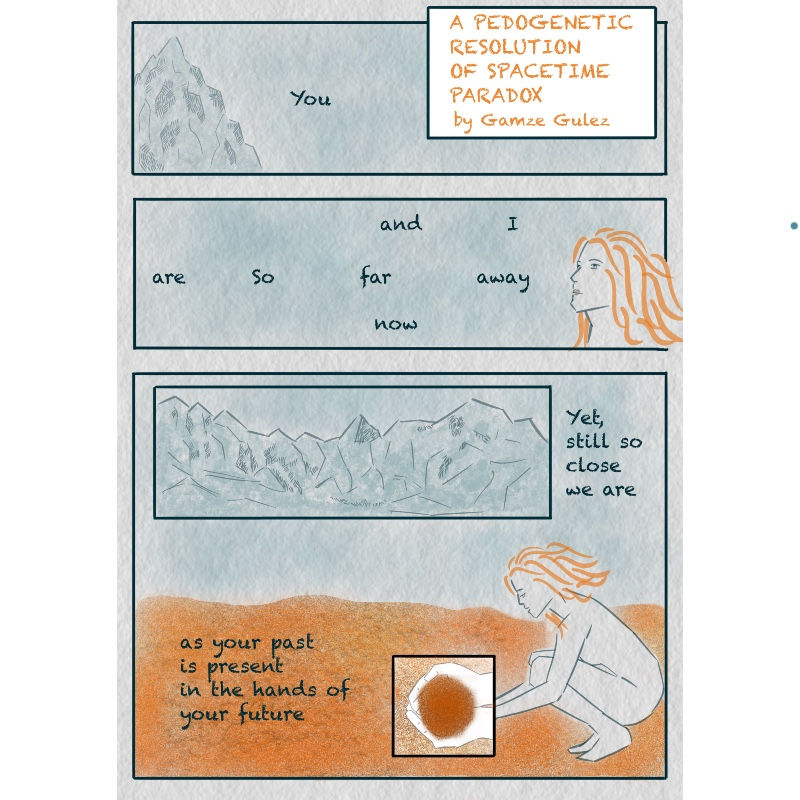
A PEDOGENETIC RESOLUTION OF SPACETIME PARADOX
I once had a conversation with someone who couldn't grasp why I consider soil and rocks to be integral parts of life. To them, anything defined as “non-living" simply wasn't worth considering.
This experience and my deep appreciation for the interconnectedness of all life inspired this story. It explores the science of soil formation (though a bit simplified) interwoven with philosophical inspiration from paradoxes in physics, a longing for mountains, cycle of life and mythology.
And what better way to do it than with a comic medium? It's paradoxical form itself, where a page can show time separately and at once. Something that makes your brain tingle.
I hope this little story sparks an appreciation for the soil and the interconnectedness of life . In the age of multiple crises, that is what we need most.


MURMUR OF LIFE
This one is dedicated to my grandma, who passed away recently.
A Beckettian scene
played out in my mind
upon hearing your words
I knew why.
Your pain was your anchor
your cries to shoo death.
Yet, gravity was stronger
then your still sharp mind
Earth was ready to end your
long lasting agony.
Hope you decompose peacefully
You have been, for long, in agony
Hope you will decompose peacefully
---
Microbiology of death is complex and there is a lot to discover, but we at least know that human decomposition involves succession of key species belonging to diverse group of microorganisms like bacteria, fungi, nematodes. These key species are found inside the body, outside the body, in the soil, or carried with flies, insects, etc. Each of these species dominate at some time point during the decomposition, giving ways to others either by predatory or competitive behavior. Here I summarized the process briefly; emphasis on the transformation and death being part of life.
ICOSAHEDRON SELF
Using stellated icosahedron as a metaphor, I explored the making of the self.
Self is constantly reformed, constructed, deconstructed to grow, to adapt, to survive. We exist as entangled and disentangled multiple selves. A continuous, transformative cycle of making our-selves.
What is self?
How do you visualize the self? Does it have shape?
How does one change and adapt?
What is a crisis? Is it disentanglement of multiple selves? Or deconstruction of the self? Or both?


RESPONSE TO EXCESS
A bit of plant science, a bit of optical physics, fluid dynamics, a bit human emotion and physiology
Guttation: Fluid exuded from the tip, edges or surface of a leaf to relieve water pressure.
Optical Physics: The image in droplets looks upside down due to refraction.
Fluid Dynamics: Guttation fluid and human tears are both examples of gravity-driven ejection, droplets forming at the tip start to fall under gravity after reaching the critical mass.
(I also remember reading that some hormones in guttation fluid and human tears are similar, but I can't find the reference. Human tear composition changes depending on the cause of tear production: sad tear, irritation tears, etc all have different chemical composition.)
Foundational and Conceptual Inquiries

BIOFILM AS MULTIFACETED MATERIAL coming soon
I explore microbial biofilms as a material from different aspects and functions.
HYPERBOLIC SURFACES
A hyperbolic surface is a surface with negative curvature, defined by an exponential growth that constantly pushes the structure outward, creating folds. A faster rate of growth over a surface area leads to a more ruffled, compactly folded shape.
Such surfaces are not just in the realm of geometry; from the ruffled edge of a sea slug, corals to the lettuce leaves there are numerous examples in nature.These natural forms adopt hyperbolic shapes to maximize surface area within a given volume, which is critical for nutrient absorption and exchange.
To model these structures, I use crochet which has been popularized by the mathematician Daina Taimina. When crocheting with a constant increase in stitches per row (i.e., maintaining a constant, exponential growth), the fabric naturally begins to ruffle and fold, demonstrating the negative curvature of hyperbolic space.
As someone who works with microbes, I naturally look for similar structures in microbial world. It is not easy to find coral like structures in microbial world, but similar structures have been observed in some agar grown colonies. As a microbial colony grows exponentially, constrained by its attached growth and substrate adhesion, the internal compressive stress builds up. This stress is relieved through a process called buckling, creating macroscopic ridges and wrinkles on the colony surface. This raises several research questions while I add each stitch:
Are there more hyperbolic forms that microorganisms can take?
Can we harness microbial behavior by embracing hyperbolic design?
How else can I apply hyperbolic surfaces in my research?

By increasing and decreasing growth rate, changing the algorithm, I end up with something unique each time. Which also pops in questions of differential growth and morphogenesis, how growth rate, which is function of multiple factors, results in different forms, like organs, even when everything started with one single cell. What about our own morphogenesis?The physical laws observed in yarn and cell colonies offer a reflection opportunity on the human condition: We, too, are systems under constant growth—in knowledge, relationships and experience. Our "growth rate" is affected by our traits and our environment.
How does the pace of our individual lives determine our shape (of self)? What makes us slow down, accelerate, or stay at constant velocity?
How am I changing with each stitch I am making while thinking all these connections, similarities, analogies, metaphors, science?
MODULAR ORIGAMI AND POLYHEDRA
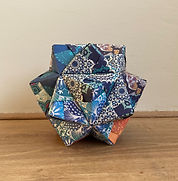
For me making modular origami, like many similar crafts, is a multidimensional process such that I experience both focused and wandering mind at the same time, while focused on creating the specific shapes my mind also wanders beyond from the tactile experience of the different papers and structures, scientific applications to self reflections.
(Nautilus is not modular origami, it is made with single piece of paper )


TESSELLATIONS (and tessellation based drawings)
From Escher’s drawings, islamic geometric art symbolizing infinity, unity and diversity, Penrose’s puzzles, mineral structures and fracture resistant material design for multiple applications, one thing is always true: tessellations are simply beautiful. Looking at them, getting lost, being immersed in illusions is mesmerizing. Making them whether piece by piece like a jig-saw puzzle, or with a ruler and a compass, or with your programmed algorithms in computer program, is such a joyful and mind stimulating process as well. (I use procreate to manually make tessellations by making the shapes first and then tiling them like making a jig-saw puzzle, so my tessellations are not as perfectly tiled when you do the same with a vector based application that can attach shapes node-to-node, but it is my process, and I love it. Emphasis on the process! A process which eventually brings me to microbiology and bioprocess design & engineering again.
Can microbial biofilms form tessellated patterns?
Microbial colonies can form beautiful patterns, some grow as fractals some with wrinkles, typically observed in single or dual-species colonies on agar surfaces. As for tessellations, only a few papers report such phenomena, limited mainly to Voronoi tessellations. But are there other tessellated patterns in the microbial world? This is a difficult quest, I know, as the microbial world is quite dynamic.Yet, the pursuit itself is valuable. It is great to contemplate these possibilities—even if microbial biofilms prove too dynamic, or if such patterns are exceptionally rare, or even impossible. Asking such questions invariably leads to discovery, often revealing new insights, even if they aren't what we initially set out to find. In the meantime I can focus on grow my own tessellated grown microbial biofilms for specific applications by confining them, or tessellated surfaces to embrace certain behavior of microbes.
Other Impressions
Cosmicomics Impressions


Inclusive and Accessible Design
My sensitivity to inclusion and accessibility, while always present, has been dramatically increased by my direct experience in living and working in multiple countries, teaching and mentoring, my design interests, self-training and critical thinking.
I integrate principles of social design into my creative practice, ensuring that scientific knowledge and visual narratives are accessible, culturally sensitive and meaningful to the widest possible audience to the best of my ability.
Example: Comic is a medium already offering accessibility to people with diverse learning styles and literary levels. My educational fictional comic stories include sub-plots that relates to complex human issues. They explore themes such as overcoming prejudices rooted in fear, adapting to loss of mobility, navigating isolation, finding belonging and courage. My latest book format uses a square layout with one panel in each page and text with large fonts, making it easier to read either as a digital or printed comic.
While my efforts have primarily focused on cultural, personal and learning differences, I am currently exploring and developing accessibility strategies to communicate my work and practice research.
Multi-Modal Accessibility
(Microbiology) Comics for Blind and Visually Impaired People: This is quite a challenge as many would acknowledge, but this challenge is paradoxically intensified for the microbiology comics, as my motto there is to make the invisible world visible. However, this same challenge is also its strength: figuring out how to depict, describe and tell the story; what to compromise and how to bridge the known with the unknown are already central to my creative process, given that we only have a glimpse of how microorganisms behave (despite our advanced tools).
I prototyped accessible versions of 2 comics. First one is science inspired reflection comic, second one is an educational comic about microbiology.
Comic 1: Pedogenetic Resolution of Spacetime Paradox
Due to diverse needs and preferences of blind and visually impaired people, my initial intention was to produce 2 - 3 prototypes of this comic, some with music and sound effects. My goal for Version 2 was to create a composition that captured the feeling of “all time happening at once” and the transformation process. I experimented with my original sounds, ready-to-use jingles and even tried AI generated music for the prototyping purposes only.
Ultimately, I decided that for a such poetic comic story, 'less is more'. I discovered that background music and sound effects often interfered with the fast-paced speech. [Note that while I prefer human-made music for my final output, I envision that in the future AI can be employed for highly personalized accessibility versions, allowing to adapt to each user's unique sensory needs beyond sound differences.]
The following table documents the final design logic.

Tactile Map: Intent & Methodology
I also prototyped a tactile comic map designed to serve as a spatial literacy tool to accompany the audio-video experience. This physical prototype was created to test accessible materials and layout methods. While this iteration focuses rapid accessible prototype, I envision future versions that transcend to exist as standalone tactile art pieces. The table below outlines the decisions made during prototyping:

Scientific Research and Education
I am also exploring solutions for accessible research and education, especially in microbiology laboratory settings. Below are experiences of some of the disabled scientist in other fields as well examaples of accessible wet lab practices in chemistry:
https://monaminkara.com/fellow-blind-scientists#gsc.tab=0
https://blindnewworld.org/exploring-our-universe-through-sound/
Comic 2: Halophiles (Salt-Loving Organisms)
This is one of the chapters from Volume 1 of the educational microbiology comic series Invisible Wonders. Here are 2 versions, second one having a few sound effects compares to the first version.
I used AI generated voice for the voiceover, as different voices are needed when there is a dialogue between characters.